
How to use vitamin C serum: dry skin or wet fingertips?
Most advice says to put vitamin C serum on dry skin, and for water-based serums that's right. A water-free serum like 04 BRIGHTEN Vitamin C Serum 20% still goes on dry skin, but you massage it in with wet fingertips. Here's the full morning routine, how much to use, how often, and what to keep for the evening.
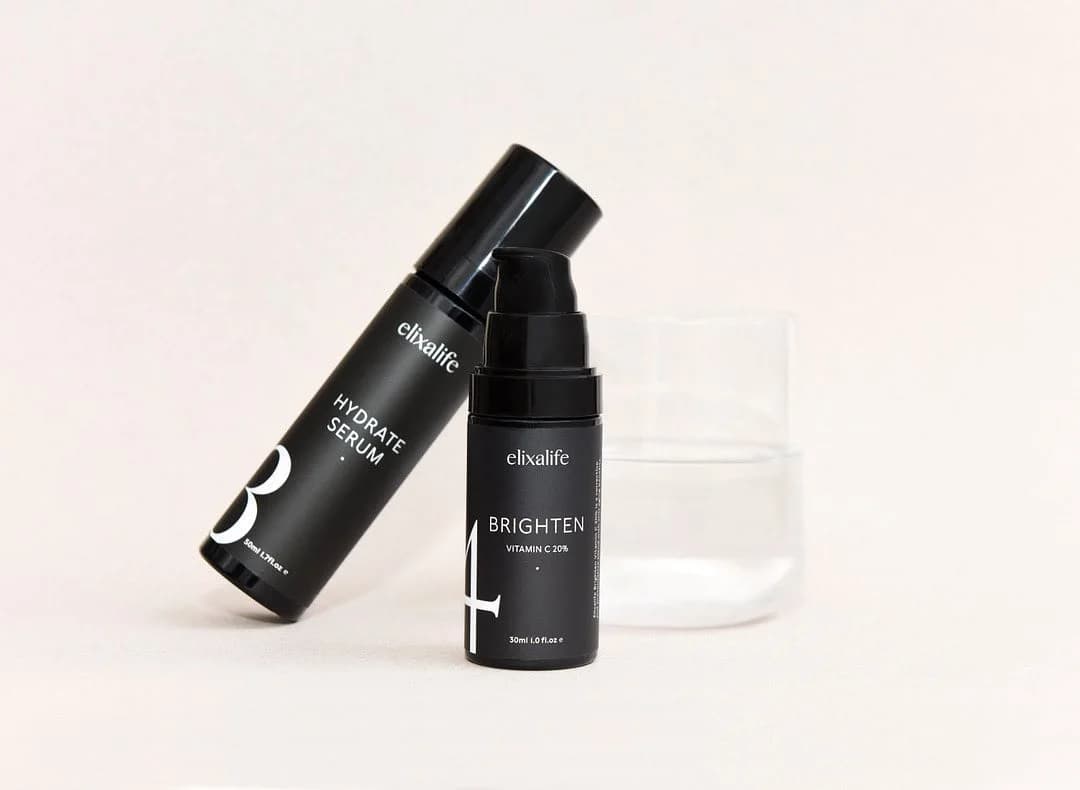
Use vitamin C serum once a day, in the morning, on clean skin: after your hydrating serum and before moisturiser and SPF 30 or higher. With a water-based serum, apply it to dry skin. With a water-free serum such as 04 BRIGHTEN Vitamin C Serum 20%, skin is still dry, but you massage it in with wet fingertips.
Should vitamin C serum go on dry or damp skin?
Search "how to use vitamin C serum" in Australia and Google's AI Overview tells you to apply it to dry skin. The reason it gives is that damp skin can increase penetration and irritation. For most vitamin C serums on the shelf, that's sensible advice.
Most vitamin C serums are water-based. The vitamin C (ascorbic acid) is already dissolved in water inside the bottle, usually at a low pH. A 2017 review by Al-Niaimi and Chiang notes that bringing the pH below 3.5 helps ascorbic acid stay stable and reach the skin. A serum like that doesn't need extra water from you. So for a water-based serum: clean, dry skin and dry hands.
Water-free serums work differently. Ascorbic acid is the pure form of vitamin C, and it breaks down easily in water, light and air. A 2024 paper by Abric and colleagues describes vitamin C as "highly unstable in aqueous solution", which is why some formulators leave the water out altogether.
BRIGHTEN is one of them. It contains 20% ascorbic acid, stabilised with vitamin E, with grapeseed, macadamia and evening primrose oils, and no water. Liz's directions are to apply it to clean, dry skin each morning and massage it in with wet fingertips. Ascorbic acid is water-loving, and the water on your fingertips activates the vitamin C as you apply it.
So the two pieces of advice agree more than they first appear to. In both cases your skin is dry. The difference is where the water comes from: in a water-based serum, it's already in the bottle; in BRIGHTEN, it's on your fingertips.
A quick way to check your own serum: read the ingredient list. If water (aqua) is first or near the top, it's water-based: dry skin, dry hands. If there's no water and the directions mention wet fingertips or damp skin, follow the maker's directions. We explain the formulation side in more detail in water-free vitamin C serums: what anhydrous means and why it matters.
When to use vitamin C serum: day or night?
Use it in the morning. BRIGHTEN's directions say each morning, and there are two good reasons for that.
First, sunscreen. Studies on ascorbic acid describe it as an antioxidant, and Al-Niaimi and Chiang note that sunscreens are only partly effective against the free radicals (unstable molecules) produced by UV exposure. They present topical vitamin C as an addition to sunscreen, not a replacement. In the morning the two sit together, under the same Australian sun.
Second, it keeps your evening free. If you use a retinol, or plan to, night is where it belongs, so the two strongest steps in a routine never go on at the same time.
How to apply vitamin C serum: a morning routine, step by step
Here's the whole morning routine, in the order the pack numbers suggest.
- Cleanse and pat your face dry.
- Apply 03 HYDRATE + Hyaluronic Serum. One to two pumps, massaged in until absorbed. It contains hyaluronic acid (sodium hyaluronate), vitamin B3 (niacinamide) and ceramides, and its serum-gel texture is the thinnest layer, so it goes first.
- Apply 04 BRIGHTEN with wet fingertips. Run your fingertips under the tap and shake off the drips. Pump BRIGHTEN onto them without touching the nozzle, so no tap water gets into the bottle, then massage it over your face.
- Moisturiser, if you use one. If your skin feels comfortable after the two serums, you can skip it.
- A broad-spectrum SPF 30 or higher, every morning. healthdirect suggests about a teaspoon (5ml) for each part of the body exposed to the sun, applied 20 minutes before you go outside and reapplied every 2 hours outdoors. We cover the pairing in vitamin C serum and sunscreen.
In the Elixalife routine: 03 then 04 in the morning, then moisturiser if you use one, then SPF.
How much vitamin C serum should you use?
For HYDRATE, the directions are one to two pumps. BRIGHTEN's directions don't give a pump count, so start with one pump on wet fingertips. If that doesn't spread across your face in a thin, even layer, use a little more the next morning.
A thin, even layer is the aim. Because BRIGHTEN contains plant oils, more than you need mainly leaves a slicker base under your sunscreen.
The strength matters more than the amount. Al-Niaimi and Chiang suggest choosing products in the 10% to 20% range, and note that going above 20% doesn't add to vitamin C's effect and might cause some irritation. BRIGHTEN sits at 20%, the top of that range. That's one reason we suggest a slower start for sensitive skin, below.
How often should you use vitamin C serum?
Every morning. Daily use is what the directions describe, and consistency matters more than quantity.
If your skin is sensitive, start more slowly. Patch test on a small area along your jawline first, then use BRIGHTEN every second morning for a week or two before moving to daily. Stinging, redness and dryness are uncommon reported side effects of topical vitamin C; if they continue, stop and speak to your GP or a dermatologist.
Set honest expectations. Hydration from HYDRATE is felt straight away. For the look of brighter, more even-looking skin, give vitamin C 8 to 12 weeks of daily use. Several of the studies in the 2017 review ran for 12 weeks or longer.
Look after the bottle, too. Keep the cap on and store BRIGHTEN somewhere cool and out of direct sunlight, not on a sunny bathroom windowsill. Light and air both help break vitamin C down.
What not to layer with vitamin C serum in the morning
Some steps are better kept for another time of day. In the morning, leave out:
- Retinol. Keep it for night. In the Elixalife routine, 05 RENEW Vitamin A Serum Retinol 0.5% goes on at night after HYDRATE. RENEW is not to be used during pregnancy or breastfeeding, and it may make skin sun-sensitive, so daily sunscreen matters even more.
- Exfoliating acids. AHAs (such as glycolic and lactic acid) and BHAs (such as salicylic acid) are acidic, like ascorbic acid. Layered together, they can add up to irritation. Use them in the evening, on nights you're not using retinol.
- Benzoyl peroxide. DermNet describes it as an oxidising agent, and vitamin C breaks down when it oxidises. Keep the two at different times of day. If benzoyl peroxide was prescribed for acne, ask your GP or dermatologist how to fit it into your routine.
- Prescription creams. If a doctor has prescribed something for pigmentation, melasma or acne, follow their directions first and check with them before adding a vitamin C serum.
What's fine in the morning: hyaluronic acid, niacinamide, moisturiser and sunscreen. HYDRATE contains both hyaluronic acid and niacinamide, and BRIGHTEN is designed to go on straight after it. For the full list of pairings, read which serums can you use together.
Key takeaways
- Use vitamin C serum once a day, in the morning, before moisturiser and a broad-spectrum SPF 30 or higher.
- Water-based vitamin C serums go on dry skin with dry hands. Water-free BRIGHTEN goes on clean, dry skin, massaged in with wet fingertips.
- The morning order is 03 HYDRATE, then 04 BRIGHTEN, then moisturiser if you use one, then sunscreen.
- Start with one pump of BRIGHTEN and aim for a thin, even layer. Sensitive skin can start every second morning.
- Keep retinol, exfoliating acids and benzoyl peroxide away from your morning vitamin C, and give it 8 to 12 weeks for the look of a more even tone.
Ready to build your two-serum morning routine? Shop 04 BRIGHTEN ($88) and pair it with 03 HYDRATE ($68): two serums ship free. If you're not sure how BRIGHTEN fits around something your clinician or doctor has given you, ask Liz a question.
Questions
Can I use vitamin C serum every day?
Yes. BRIGHTEN's directions are to apply it each morning. If your skin is sensitive, patch test first and start every second morning for a week or two, then move to daily once your skin is comfortable. For the look of a brighter, more even tone, plan on 8 to 12 weeks of daily use, with a broad-spectrum SPF 30 or higher every morning.
Do you put hyaluronic acid or vitamin C first?
Hyaluronic acid first. In the Elixalife routine, 03 HYDRATE goes on cleansed skin and is massaged in until absorbed, then 04 BRIGHTEN goes over it with wet fingertips. The numbers on the packs follow the order you apply them, so the morning routine is simply 03, then 04, then moisturiser if you use one, then sunscreen.
Should you apply vitamin C serum on damp skin?
It depends on the formula. For a water-based vitamin C serum, apply it to dry skin with dry hands, as most guides say. For a water-free serum, follow the maker's directions. BRIGHTEN goes on clean, dry skin, massaged in with wet fingertips: the water on your fingertips activates the vitamin C as you apply it. Check your label for water (aqua) to tell which kind you have.
Should I use vitamin C serum if I have dry skin?
You can. Put a hydrating serum on first, so skin feels comfortable before the vitamin C goes on. BRIGHTEN contains grapeseed, macadamia and evening primrose oils alongside its 20% vitamin C, and you can follow it with your usual moisturiser before SPF. If your skin feels tight or stings, drop back to every second morning and see your GP or a dermatologist if it continues.
Sources
- Al-Niaimi F, Chiang NYZ. Topical vitamin C and the skin: mechanisms of action and clinical applications. J Clin Aesthet Dermatol, 2017
- Abric E et al. Anti-spot, lightening effect and cutaneous acceptability of a stable anhydrous ecobiological formulation of 10% L-ascorbic acid. Clin Cosmet Investig Dermatol, 2024
- DermNet: Benzoyl peroxide
- healthdirect: Sunscreen
This guide is general information about cosmetic skincare, not medical advice. For a skin condition, or if you are pregnant or breastfeeding, talk to your GP or a dermatologist. Questions about our serums?